

Stella Huang purchased her initial Jellycat brand cuddly companion during a period of unemployment during the global health crisis. Encouraged by a friend's passion for the British-designed creatures, her curiosity was fully sparked upon seeing an adorable gingerbread house design on a widely-used Chinese social media app.
While Christmas is not widely celebrated in China, acting more as a retail occasion rather than a cultural tradition, the imagery of festive cottages resonated with her. "It doesn't mean much for me... However, I always like the sight of those sweet houses," she remarks. This prompted her to eventually request an old friend in Guangzhou to buy it for her.
That purchase took place back in 2021, right as the brand was poised of achieving significant success across China and beyond. "People were anxious, and no-one knew what would happen," says Stella, who developed a routine of petting and squeezing her plushies for comfort during that stressful time. Residing in Beijing, a city with among the strictest lockdowns globally, she passed a great deal of time indoors.
Now 32 and working in tourism sector in the tourism industry, Stella still grow her collection. It has swelled to approximately 120 items, with a total an investment of roughly 36,000 yuan. "As an adult, you have many things you can't share with others... and the troubles we face are a lot more complex than in the past," she notes reflectively. "These soft toys help me managing my feelings."
Originally designed with kids in mind, these soft creatures have evolved into an international phenomenon, particularly within China where an somewhat disillusioned younger generation is turning to them for emotional support.
The Rise of Adult Toy Enthusiasts
Stella's gingerbread cottage toy belongs to the "Amuseable" collection, a set of toys featuring small expressions modelled after everyday inanimate objects, ranging from toilet rolls to hard-boiled eggs. These items have become the "breakout success" that "resonate with a wide Gen-Z and millennial demographic" globally, according to industry analysts.
The surge in appeal "could have something to do with a desire for a sense of connection," propose experts. It is difficult to say for sure whether the introduction of the iconic series back in 2018 was an intentional strategy to engage the adult market, companies in the sector are under pressure to must find alternative audiences due to falling birth rates across numerous parts of the world.
The brand made its foray into China as early as 2015. By laying the necessary "groundwork", the toy maker was able to tap into "the mood of the pandemic"—when individuals looked for solace amid heightened anxiety—capitalizing on its early momentum there, as explained by business consultants.
Its fame was also propelled by creative temporary events. These in-store events sometimes offered a menu of limited-edition "food" products. Numerous enthusiasts record their experience being served and share the videos online.
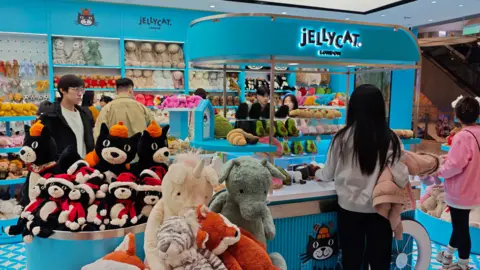
Localisation has also been an essential approach. For instance, customers were able to buy plush interpretations of traditional UK dishes like fish, chips and mushy peas at a pop-up overseas. Meanwhile, items like teacup and teapot plushies were featured at special outlets in Chinese metropolises last year.
Last year, the UK-based company's sales is said to have increased significantly to reach a substantial sum. During that period, it sold roughly $117 million in value of toys in China on major e-commerce platforms, according to research estimates.
This expansion parallels a broader boom within China's collectible toy market among young adults in search of emotional support and connection. Total revenue from collectible items nationally are projected to exceed 110 billion yuan this year, according to a 2024 analysis.
The remarkable success of brands like Labubu, elf-inspired figures by Chinese toy maker Pop Mart, underscores the market's growing demand towards designer collectibles. The so-called "kidult" phenomenon is not unique to China; young adults worldwide are increasingly question "outdated notions of adulthood," observe cultural experts.
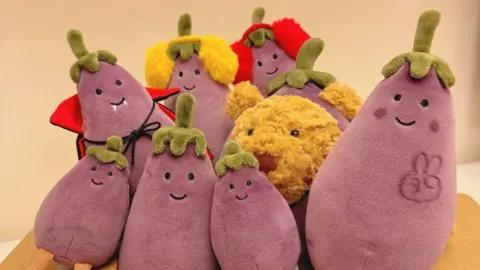
Particularly, especially the eggplant character—nicknamed "the big boss" in China—have spawned a wave of online jokes, where users sharing frustrations regarding adult life. The "aubergine boss" tag is a space where fans sketch various emotive faces on their toy, depicting it in different states enjoying a drink to forcing a smile.
For example, a marketing professional from Hong Kong, Wendy Hui, personalized her eggplant toy adding bags under its eyes and putting spectacles on the toy. She then shared an image online captioning it: "The mood of workers on Monday." "I kept working at home even on my days off," she explains. "I just wanted to express how exhausted I felt."
Thus, Jellycat has become an unexpected, whimsical outlet for China's youth to air their frustrations about a slowing economy, in which dedicated effort doesn't always ensure comparable returns. Amid heavy content regulation, the internet have become a crucial, if not the only, arena for such conversations.
The brand's regular launches of limited-edition products coupled with the discontinuation of older designs—an approach often called "scarcity marketing" in China—has also fueled {

